Viewing 1 - 7 of 7 Results
View Filters
Web Exclusive
Web Exclusive
Web Exclusive
Web Exclusive
Web Exclusive

#myrcwilleyhome

See how real customers are transforming their spaces with RC Willey. Get inspired, share your style, and create a space that's Your Home. Your Way.

Explore Now

Portable Fans and Box Fans at RC Willey: Cool Air, Any Room, Any Budget

Air conditioning does the heavy lifting, but it can't do everything. It can't direct a focused stream of cool air exactly where you're sitting. It can't circulate stale air out of a garage or workshop. It can't quietly hum beside your bed on a warm night without running your whole HVAC system. And it certainly can't follow you from room to room.

That's what a portable fan is for. Simple, affordable, and genuinely effective at making spaces more comfortable — fans are one of the most practical home comfort purchases you can make. Whether you need a powerful box fan to pull fresh air through a window, a tower fan for a quiet bedroom, or a pedestal fan to cool a large gathering space, there's a format built for exactly that job.

At RC Willey, we carry fans across every type, size, and price point. Browse our full heating, cooling, and air quality selection to find the right fan for your space.

Why a Fan Still Makes Sense Even When You Have AC

Air conditioners cool air. Fans move air. These are different things, and understanding the difference helps you use both more effectively — and more economically.

A fan doesn't lower the temperature of a room. What it does is create airflow across your skin that accelerates evaporative cooling — the same process that makes wind feel cool on a hot day. This means fans work best when you're in the room with them. Running a fan in an empty room provides no benefit.

What fans do accomplish that AC alone can't:

Supplement your air conditioning at lower cost. Running a ceiling or floor fan alongside AC allows you to set your thermostat 4 to 6 degrees warmer while maintaining the same comfort level — the airflow compensates. That difference represents meaningful energy savings over a full summer.

Circulate air in rooms AC doesn't reach well. Hot spots, dead corners, rooms at the end of long HVAC duct runs — a strategically placed fan can address all of these without extending or upgrading ductwork.

Ventilate spaces that benefit from fresh air exchange. A box fan in a window, drawing outdoor air in or pushing indoor air out, provides genuine ventilation — removing cooking odors, moisture, and stale air more effectively than any recirculating appliance can.

Provide cooling where AC isn't available. Workshops, garages, covered outdoor areas, and older homes without central air all benefit from portable fans in ways that AC can't easily address.

The Types of Portable Fans — and How to Choose Between Them

Box Fans

A box fan is the most utilitarian format in the portable fan category. It's a flat, square unit — typically 20 inches across — housing a large blade set behind a protective grille, designed for raw airflow volume and practical placement flexibility.

Box fans move a high volume of air efficiently and inexpensively. Their flat profile makes them easy to fit in window openings for room-to-room or indoor-to-outdoor ventilation — one of the few fan types that genuinely improves air quality by exchanging indoor air with outside air rather than simply recirculating what's already there. Pointed inward, a box fan pulls cool nighttime air into a room. Pointed outward, it exhausts hot, humid air. Combine the two in different windows and you create a whole-home cross-ventilation system that can significantly reduce how long AC needs to run on mild evenings.

Box fans are also the most affordable portable fan format — quality 20-inch models from major brands like Lasko and Comfort Zone run as low as $30 to $70. They're not the quietest fan type, and they're not elegant, but for raw airflow and value, nothing in the portable fan category competes.

Box fans are best for: Window ventilation, high-airflow bedroom cooling on a budget, workshop or garage air movement, and any situation where raw CFM matters more than aesthetics.

Tower Fans

Tower fans are the design-forward option in the portable fan market. A slim, vertical column that stands 36 to 52 inches tall, the tower fan oscillates at the base to distribute airflow across a wide angle. Most include remote controls, multiple speed settings, sleep timers, and sleep modes that gradually reduce fan speed after you fall asleep.

The defining advantage of tower fans is their noise profile. The internal blade design and housing produce significantly less noise than a box or pedestal fan at comparable airflow — making tower fans the natural choice for bedrooms, home offices, and any space where background noise matters. They're also considerably easier to live with aesthetically — they blend into a room corner rather than sitting in the middle of the floor looking like an appliance.

The tradeoff is airflow power. Tower fans don't move air in the same volume as pedestal or box fans. They're designed for personal and room comfort cooling, not for high-velocity ventilation or cooling large open spaces.

Tower fans are best for: Bedrooms, home offices, apartments, and any space where quiet operation and clean aesthetics are a priority.

Pedestal Fans (Stand Fans)

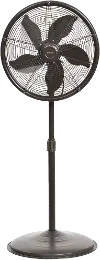
Pedestal fans are the high-performance option among portable fans — a large circular blade head mounted on an adjustable height stand, typically oscillating side to side to distribute airflow across a room. The adjustable height (most pedestal fans range from 36 to 54 inches) allows you to direct airflow exactly where you need it: down toward seated guests, straight across a bed, or angled upward to promote air mixing in a room with a high ceiling.

The blade size and motor design of pedestal fans move significantly more air than tower fans — making them the practical choice for larger spaces, outdoor use, or any situation where you genuinely need to cool a larger area. They run louder than tower fans, but the raw airflow makes them genuinely effective in ways quieter fans can't match.

Pedestal fans are best for: Living rooms, open floor plans, outdoor spaces, larger bedrooms, and households that prioritize cooling performance over quiet operation.

Personal and Desk Fans

Personal fans are compact units — typically under 9 inches in height — designed for targeted, close-range airflow at a desk, nightstand, or workspace. Most are under $30 and connect via USB or standard plug. They're not meant to cool a room; they're designed to keep one person comfortable at close range without affecting the broader environment.

Personal fans are best for: Desk use, travel, dorm rooms, and supplementing AC or other fans at close range.

Fan Type Comparison

Fan Type Typical Size Airflow (CFM) Noise Level Best Use
Box Fan 20 inches 1,500 to 2,500 Moderate to high (60 to 70 dB) Window ventilation, budget cooling
Tower Fan 36 to 52 inches tall 500 to 1,500 Low to moderate (40 to 55 dB) Bedrooms, offices, quiet spaces
Pedestal Fan 36 to 54 inches adjustable 1,000 to 2,500+ Moderate (50 to 65 dB) Living rooms, large spaces, outdoors
Personal/Desk Fan Under 9 inches 100 to 400 Very low (30 to 45 dB) Desk, nightstand, close-range

Key Features to Evaluate

CFM — What It Means and Why It Matters

CFM stands for cubic feet per minute and measures how much air a fan moves per unit of time. Higher CFM means more air movement and more effective cooling for a given space. As a general guide, you want roughly 1 CFM per square foot of room space for light cooling, and 2 to 3 CFM per square foot for strong airflow. A 20-inch box fan delivering 2,000 CFM is well-suited for a standard bedroom; a large living room benefits from a high-output pedestal fan in the 2,500+ CFM range.

Noise Level (dB)

Fan noise is measured in decibels. The lower the number, the quieter the fan. Here's a practical reference:

dB Level What It Sounds Like Typical Use
30 to 40 dB Near-silent - like a whisper Sleeping, focused work
41 to 50 dB Very quiet - soft hum Bedrooms, offices
51 to 60 dB Moderate - noticeable but not disruptive Living rooms, general use/td>
61 to 70 dB Clearly audible - useful as white noise Box fans, high-power cooling

For bedroom use, look for fans rated under 50 dB on their highest setting. Tower fans from quality brands typically achieve 40 to 50 dB. Box fans typically run 60 to 70 dB — louder, but that noise is also what some people find useful as white noise for sleep.

Speed Settings

Most portable fans offer 3 speed settings. Premium models — particularly tower fans — offer 4, 8, or more speed increments, which allows finer control over both airflow and noise level. More speed options are particularly valuable for bedroom use, where the difference between setting 1 and setting 2 on a 3-speed fan may be the difference between comfortable and too loud.

Oscillation

Oscillation refers to the fan's side-to-side sweeping motion that distributes airflow across a wider area rather than in a fixed direction. Most tower fans and pedestal fans include oscillation as standard; most box fans do not. Oscillation range varies — standard is 90 degrees; some models offer 120 or even 180 degrees for broader room coverage.

Timer and Sleep Mode

A programmable timer allows the fan to run for a set period and shut off automatically — useful for bedtime use when you want to fall asleep with airflow but don't want the fan running all night. Sleep mode, available on select tower fans, gradually reduces fan speed over time as the room cools, reducing noise as you move toward deeper sleep.

Remote Control

Remote controls are standard on most tower fans and higher-end pedestal fans. For bedroom use especially, the ability to adjust speed and turn the fan off without getting up is a genuine convenience rather than a luxury. Basic box and pedestal fans typically require manual control at the unit.

Energy Use

Portable fans are significantly more energy-efficient than air conditioning. A quality 20-inch box fan typically draws 50 to 100 watts — compared to a window AC unit drawing 500 to 1,500 watts and a central AC system drawing considerably more. Running a box fan costs approximately 1 to 2 cents per hour at average electricity rates. Even running a fan 8 hours per night throughout a full summer adds up to only a few dollars.

Reasons to Buy a Portable Fan

  1. Affordable Comfort Without Ongoing Operating Costs: A quality box fan costs $30 to $70 upfront and pennies per hour to run. Even a premium tower fan rarely exceeds $200. For the level of comfort improvement they provide, portable fans are one of the best value-per-dollar home purchases available.
  2. Move It Where You Need It: Unlike window AC units or ceiling fans, portable fans go where you go. Bedroom at night, living room during the day, garage on the weekend, back patio on a warm evening — the same fan serves all of those uses.
  3. They Work Alongside Your AC, Not Instead of It: Using a fan alongside air conditioning allows you to set the thermostat higher while maintaining the same comfort level. The airflow compensates for the temperature difference, and the savings on AC operation over a summer more than offset the cost of the fan.
  4. Ventilation You Can't Get From Recirculating Appliances: A box fan in a window moves actual outdoor air into or out of your home — something no recirculating fan or air purifier can do. For cooking odors, bathroom humidity, workshop fumes, or simply stale indoor air, window ventilation with a box fan is the most effective and lowest-cost solution.
  5. No Installation Required: Portable fans plug into a standard outlet and start working immediately. No ductwork, no installation appointment, no permanent modification to your home. Set it up, plug it in, done.

Let's Talk Through the Details

  • Do fans actually cool a room, or just the people in it? Fans cool people, not rooms. A fan doesn't lower the air temperature — it moves air across your skin, accelerating evaporative cooling and making you feel cooler. This means turning on a fan in an unoccupied room has no benefit. For maximum effectiveness, position the fan to direct airflow at the people using the space.
  • What size fan do I need for my room? For a standard bedroom (150 to 200 square feet), a 20-inch box fan or a quality tower fan provides adequate airflow. For a living room or open-plan space (300 to 500 square feet), a high-output pedestal fan or multiple fans positioned strategically is more effective. For large or open spaces, look for fans delivering 2,000 CFM or more.
  • Which fan is best for sleeping? Tower fans are the most popular choice for bedrooms because of their quiet operation, slim profile, and features like sleep timers and gradual speed reduction. A quality tower fan from brands like Lasko, Honeywell, or Dreo can operate at 40 to 45 dB on lower settings — nearly inaudible. Box fans are also popular for sleep because their white noise characteristic masks other sounds, even though they run louder in absolute terms.
  • Can I use a box fan as a window fan? Yes — this is one of the most effective uses of a box fan. A 20-inch box fan fits standard double-hung window openings and can be oriented to pull cool air in or push warm air out. For best results, use one fan pulling air in on the shady side of the house and another pushing air out on the hot side, creating cross-ventilation.
  • How often do portable fans need to be cleaned? Fan blades and grilles collect dust that reduces airflow efficiency and can contribute to indoor air quality issues. Wiping down or vacuuming the grille and blades every 2 to 4 weeks during regular use keeps the fan performing at its best. Most portable fans disassemble easily for cleaning; check the specific model's maintenance instructions.

FAQs

  • What is the difference between a box fan and a tower fan? A box fan is a flat, square unit that moves high volumes of air and works well in windows for ventilation. A tower fan is a slim, vertical unit that runs quieter and is designed for room comfort rather than high-volume ventilation. Box fans are typically louder and less expensive; tower fans are quieter and more feature-rich.
  • What does CFM mean on a fan? CFM stands for cubic feet per minute — a measure of how much air the fan moves. Higher CFM means more airflow and more effective cooling for a given space. A 20-inch box fan typically delivers 1,500 to 2,500 CFM; a tower fan typically delivers 500 to 1,500 CFM.
  • Are portable fans energy efficient? Yes — portable fans use dramatically less energy than air conditioning. A box fan typically draws 50 to 100 watts, costing approximately 1 to 2 cents per hour to operate. Running a fan alongside AC allows you to set the thermostat higher, reducing total cooling costs.
  • What fan is best for a large room? For large rooms, a high-output pedestal fan delivering 2,000+ CFM is the most effective choice. Pedestal fans with oscillation distribute airflow broadly across larger spaces; for very large rooms, two fans positioned to create cross-airflow is more effective than a single unit.
  • Where can I find fans at RC Willey? Browse our full heating, cooling, and air quality selection at RC Willey to see available fan models and find the right type for your space.

Find Your Fan at RC Willey

Affordable. Portable. Genuinely effective. A quality fan is one of the simplest improvements you can make to home comfort — and RC Willey carries the types and brands to help you find the right one for every room in your home.

Browse fans and cooling products at RC Willey and visit your nearest showroom to find your perfect fan.