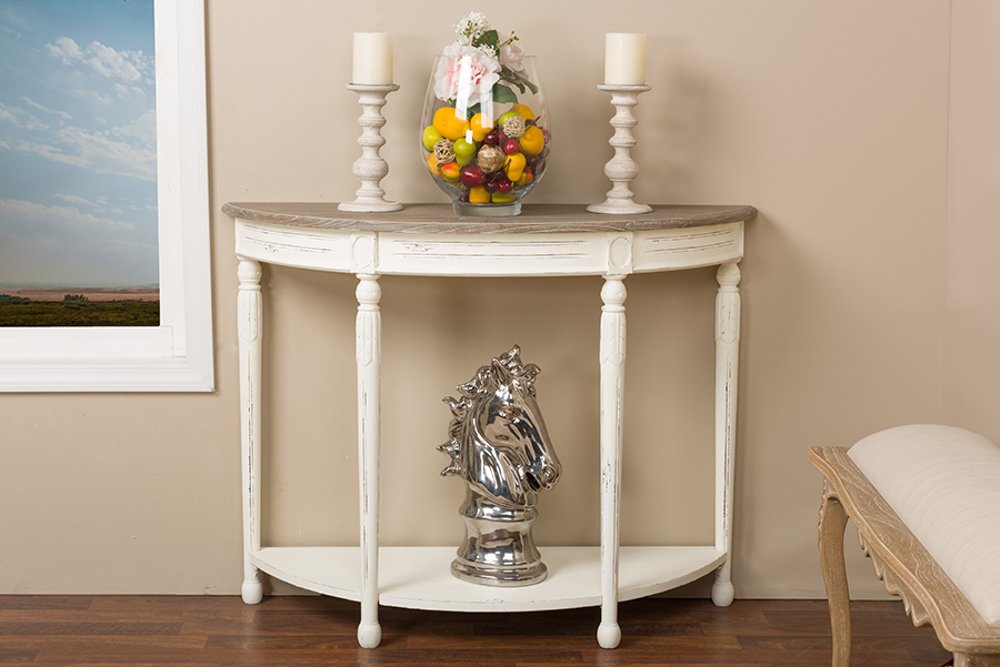
Entryway accent tables give everyday essentials a place to land and help your home feel welcoming from the first step inside. Often called console tables or foyer tables, these pieces combine a relatively shallow surface with a shape that fits comfortably along a wall, beside a staircase, or behind a sofa near an open entrance. A small bowl for keys, a lamp, and a framed photo can turn an unused stretch of wall into a useful part of your daily routine. For a busy household, that surface might hold outgoing mail and a wallet; in an apartment, it might be the only dedicated spot to set a bag while taking off shoes. Narrow entryway tables are especially useful where a full-depth cabinet would crowd the walkway. Many console tables stand about 30 to 34 inches high, while a depth of roughly 12 to 14 inches can work well in tighter spaces. Those measurements are starting points rather than rules: the right fit depends on your wall, nearby furniture, and how people move through the room. Allow room for the front door to swing fully, including its handle, and account for closet doors or drawers that open into the same area. About 36 inches of clear walking space is a helpful planning target, with more room often welcome along a busy route. The table’s widest point matters, too, since an overhanging top or splayed legs can extend beyond the dimensions you notice at first glance. A half-round accent table offers a curved front without projecting as far into the room as a round pedestal table, while a rectangular console makes good use of a straight wall. In a spacious foyer, large entryway tables can provide a more balanced scale and a broader surface for lighting, storage, and a few meaningful accents. Leaving some wall space visible at each end helps the arrangement feel intentional rather than squeezed into place.
Materials and finishes shape both the look of an entryway accent table and how it holds up to daily use. Solid wood brings natural grain and variation, with oak, walnut, and other wood types offering distinct patterns and tones. Some solid wood surfaces can be refinished, although that depends on the piece’s construction and finish. Wood veneer creates a real wood surface over a supporting core and can deliver consistent grain patterns; it needs care around edges and protection from standing moisture. Engineered wood with a laminate surface offers another option, with durability depending on the quality of the surface, edge treatment, and construction. A metal frame can give a narrow console an airy outline, while a wood top adds warmth to an industrial-style entry. Glass tops keep sightlines open and let a sculptural base stand out, though fingerprints and smudges may be more noticeable where everyone stops on the way in. Tempered glass is worth considering for added safety, but it still needs protection from hard impacts, especially along its edges. Stone and marble surfaces bring distinctive veining and substantial weight; natural stone may require sealing and can react to acidic spills, so the manufacturer’s care directions matter. Marble-look surfaces vary in composition and should be cared for according to their actual material rather than their appearance. For most tables, a soft cloth and prompt attention to spills are a good foundation, with cleaners chosen specifically for the finish. A tray beneath keys helps reduce scratches, and a protective pad under a planter keeps moisture from reaching the tabletop. Durability also comes from details that are easy to overlook: secure joints, a steady base, smooth drawer operation, and shelves suited to the weight they’ll hold. A table that looks substantial isn’t automatically designed for heavy loads. Follow weight limits and use any recommended anti-tip hardware, particularly in homes with children or pets. Entryway accent tables are designed for display and light storage, not for sitting while putting on shoes.
Storage and style work best when they reflect what actually happens at your door. A console with drawers keeps sunglasses, spare keys, and small accessories out of sight, giving the surface a calmer look without putting essentials far away. Check usable drawer dimensions if there’s something particular you need to tuck inside, since a shallow drawer may suit envelopes better than a bulky wallet or charging adapter. An open lower shelf provides room for baskets that collect dog-walking supplies or reusable shopping bags, while a shelf-free design leaves more visual breathing room. If baskets are part of the plan, measure the opening between the legs as well as the shelf depth and height. Built-in charging features can simplify a household’s drop zone, but their usefulness depends on the port type, access to an outlet, and a cord route that stays clear of foot traffic. The table’s design can connect your entrance to the rooms beyond it without matching every finish exactly. Clean lines and slim metal legs suit a modern space; distressed wood and visible grain bring a more relaxed, rustic character. Turned legs, shaped aprons, and rich wood finishes fit traditional interiors, while a painted console can add a quiet point of contrast against a neutral wall. Rounded corners may be a welcome detail beside a frequently used passage, though they don’t replace adequate clearance. Above the table, a mirror or artwork that’s slightly narrower than the tabletop often creates a balanced arrangement. A small lamp on one side adds useful light, provided its base fits securely and its cord reaches an outlet safely. Keep a clear landing spot near the front edge so there’s still room for the things you carry home. A favorite photograph, a ceramic dish, or a short stack of books adds personality without turning the surface into another place to manage clutter. Whether your entry serves one person or a household with overlapping schedules, a well-proportioned accent table makes that first few feet of home more useful, organized, and distinctly yours.
Read More